


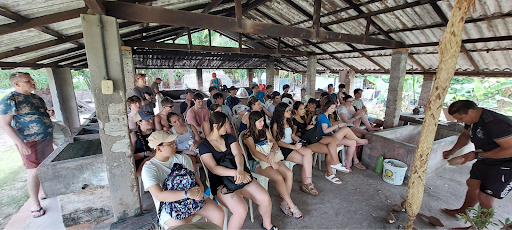
Yuca. Cassava. Manioc. The mandioca goes by many names, and this year at CWW, the 11th graders were given the opportunity to learn from a local guide, Zé Maria, about how its use goes beyond simply a vegetable, but as a crucial cornerstone in holding up the Barrerinhas economy.
Mandioca is technically classified as a root, but in common culinary use is seen as a vegetable. In the state of Maranhão, where the juniors visited for CWW, there are over 10 different varieties, all of which have evolved to match the state’s humid climate. Zé Maria demonstrated the entire process of how mandioca is transformed into the flour that powers the community. First, the plant is harvested from the earth, broken apart into roughly fist-sized pieces, and peeled. Next, it is placed into a machine that crushes the plant into a moist pulp. This pulp is then placed into an century-old indigenous tool, called a tipiti, that dehydrates the pulp. The liquid extracted in the tipiti is used to make tapioca starch, a traditional ingredient in your everyday northeastern kitchen. Inside the tipiti, only the raw flour remains, which is sifted into a fine powder.
This flour, for thousands of years, was Brazil’s alternative to traditional wheat flour, due to a variety of factors, including wheat only beginning to be cultivated in Brazil during the Portuguese colonization in the 16th century. To many local farms, its in and out-of-state sales have served as their primary sources of income, including on Zé Maria’s own farm. Historically, dry seasons and poor soil quality have had large-scale impacts on Barreirinhas’ economy, showing how important a crop mandioca is economically. According to IBGE (the Brazilian Institute of Geography and Statistics), family farming accounts for the vast majority of mandioca production, ensuring that wealth stays within local communities rather than being exported to massive agro-corporations. Beyond the local dinner table however, the mandioca economy is modernizing. Its starch, also known as polvilho, is an extremely high-demand commodity, essential in the production of pao de queijo and tapioca not just in Maranhão, but throughout Brazil. Moreover, mandioca is so versatile that it’s widespreadly used in all sorts of products, ranging from pharmaceuticals to alcohol to animal feed. Odds are, even if you claim to not like it as a food, you’ve likely used it in some other way.
While the economy moves the region, the nutritional profile of mandioca moves the people. For centuries, it has provided the caloric foundation for the grueling physical labor of the Brazilian interior. However, modern science is finally catching up to what the Indigenous peoples of the Amazon and the Northeast have known for millennia: mandioca is a nutritional marvel. The primary health benefit of mandioca lies in its status as a complex carbohydrate. Unlike refined wheat flour, which causes rapid spikes in blood glucose, the carbohydrates in mandioca are digested slowly. This provides a steady release of energy, making it an excellent fuel for athletes and those with active lifestyles. The story of mandioca is also a story of sustainability. As climate change makes water a scarcer resource, mandioca’s low water footprint and ability to grow without heavy chemical fertilizers make it a “green” crop. In the Northeast, it is often grown in “consortiums”—intercropped with beans or corn—which preserves soil health and biodiversity.
Mandioca is the perfect synthesis of tradition and innovation. For the Brazilian Northeast, it represents both a cultural and economic strength, providing a reliable income for millions of families while protecting the environment. For the consumer, it offers a powerhouse of clean, gluten-free energy and gut-health benefits that are hard to find in other staples.
Sources:
https://doi.org/10.61673/ren.2020.1271