
Why are sports dominated by women often not perceived as less legitimate as sports dominated by men, even when they require similar, if not more physical skill, strength and training?
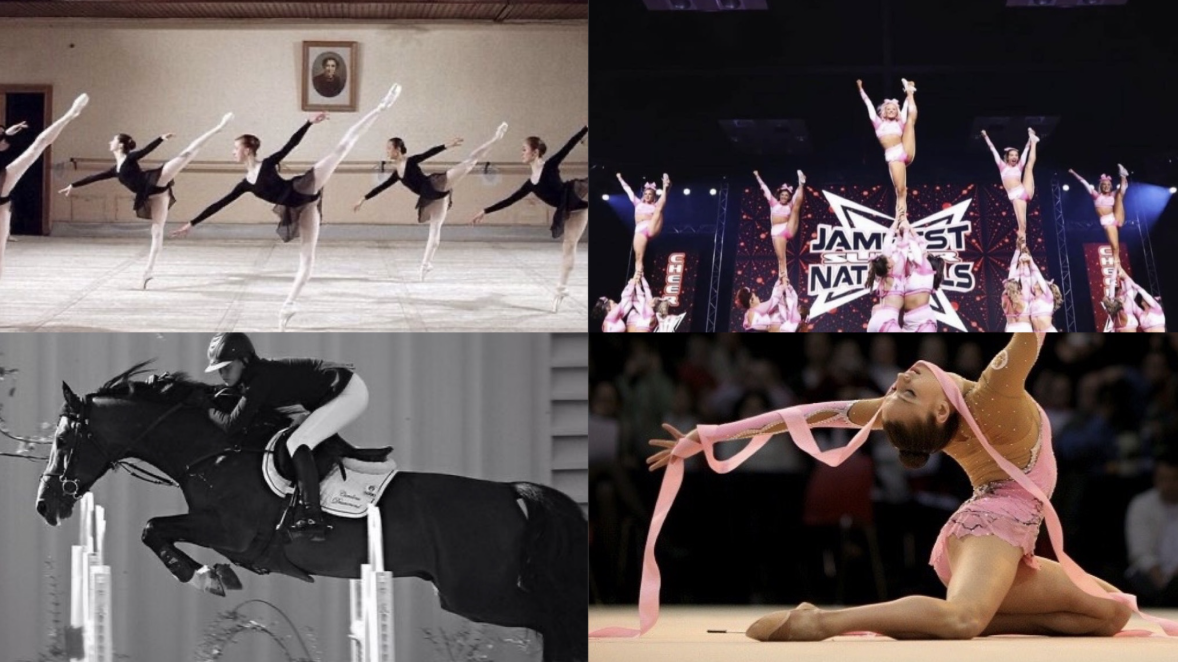
Female-dominated sports are frequently undervalued because of cultural stereotypes where sports are usually associated with masculine traits like aggressiveness and strength, while female sports tend to be associated with delicacy and beauty, causing these sports to be mistakenly categorized as art or as a hobby. Sports not only like ballet, but also rhythmic gymnastics, horseback riding, and cheerleading are viewed as performances or hobbies rather than as sports.
As a ballerina, I’ve lost count of how many times I’ve heard “ballet is not a sport.” Nothing could be further from the truth. Ballet has high physical demands, such as extreme lower body strength, flexibility, balance, coordination, endurance, and explosive power for jumps. The sport also requires high intensity training for pre-professionals, who often train 40 hours per week. It is also mostly misunderstood as not competitive, but it is a very competitive field, with competitions like YAGP that hold 15,000 young dancers per year with rigorous auditions and strict requirements. The situation is similar for cheerleading, where the sport demands a lot physically from the athlete. It also holds one of the highest injury rates among youth sports, with 86% of the athletes getting injured each season. Rhythmic gymnastics is one of the most female-dominated sports, with almost 100% of its athletes being women. It is also an olympic sport, and yet it is often undervalued and seen as a performance. Lastly, horseback riding and other equestrian sports are also misconceptualized as a hobby. The sport requires intense training for professionals, can cause serious injuries, risks, and is also an olympic sport. How can Olympic sports still hold the stereotype of not being a sport only because they are mostly performed by women?
Many people see ballet as an art form, but sports scientists have actually found that professional dancers often experience physical demands similar, or even more extreme to other elite athletes. Dancers repeatedly perform jumps, lifts, turns, and demanding movements while keeping insane technique and artistry. If we think about a football player, they can show effort through visible demonstrations. A ballerina is expected to make the same amount of effort and still look effortless and perfect all at once.
Cheerleading is often dismissed because of its association with supporting other sports, but competitive cheerleading is a separate activity involving acrobatics, tumbling, and stunts that require significant athletic ability. The situation is very similar with rhythmic gymnastics, where the athletes need a lot of strength exertion, but also need to appear graceful and artistic. No one questions whether artistic gymnastics is a sport, yet rhythmic gymnastics faces more skepticism, despite the same intensity in training only because it is overly dominated by women compared to artistic gymnasts. In horseback riding, critics often argue that the horse does most of the work. However, Riders must maintain balance, communicate subtle commands, make split-second decisions, and control their own body while coordinating with an animal at the same time. Equestrian sports are one of the few olympic sports where men and women compete directly against one another, and in dressage events, women are almost always the ones who win over men.
The sports most frequently described as “not real sports” often share two characteristics: they demonstrate grace, artistry, and delicacy, and are dominated by women. Are these sports misconceptualized as “not sports” because of their female-associated traits, or the dominance of women in the field? Are people judging these activities by their athletic demands, or by the gender stereotypes associated with them? As a female athlete, it is disappointing to see that even in a society that has made significant progress toward gender equality, these sports continue to be classified as anything but sports. The idea that a sport only counts when men dominate it says more about outdated attitudes than about the athletes themselves. Historically, society has associated athleticism with traits like aggression, physical dominance, and power, which are qualities traditionally associated with masculinity. Sports demonstrating grace, precision, and artistry, traits often associated with femininity, have therefore been viewed as less athletic despite requiring equal levels of discipline and physical ability.