
When I decided that 25 years in technology was enough and made the switch to teaching, I was astounded by how many other mid-career professionals had made the same leap. “What is it like being a teacher?” they would ask.
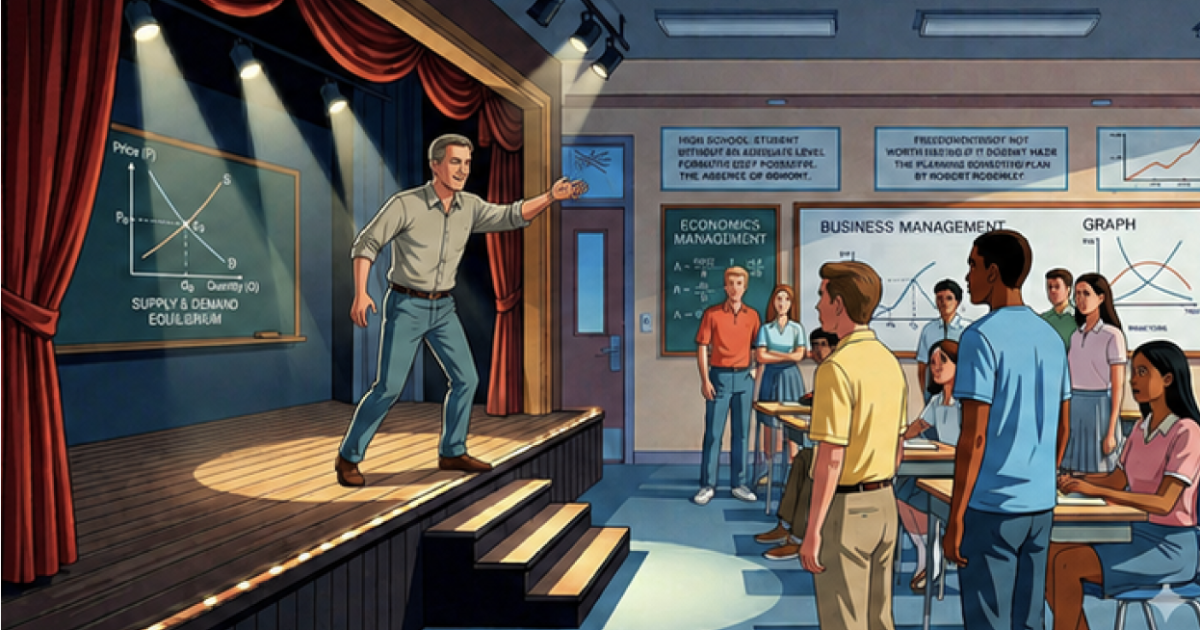
I was never quite sure how to answer. It took me a while to land on the right comparison, but I eventually settled on the theater. It may seem an odd choice, so bear with me as we step into the bizarro world of teaching-as-a-play.
The main difference between teaching and the theater? In the theater, the play and its cast stay fixed while the audience turns over night after night. In teaching, the whole arrangement is inverted: the actor stays the same, the audience stays the same, and it is the play that changes relentlessly. Over the past two years, across just my four senior classes, I staged, in round numbers, some 640 plays. That may sound like a monumental undertaking, yet it is one every teacher shares. Save for the occasional absence, the same faces filled every seat.
Over the same two years, someone in the corporate world might participate in only four to eight major projects, often with extensive planning, revisions, and support behind the scenes. Teachers, by comparison, are constantly creating and delivering new performances in real time. I would say, without hesitation, that the academic world is both more complex and less rewarding than the corporate one. Not only must you put on the play under each and every circumstance, but audience approval is essential to a long career. At times, even the audience’s parents weigh in. Imagine a parent calling Denzel Washington about his role in Fences.
Moreover, the audience labors under all manner of pressures, some self-inflicted, and faces distractions as varied as competing plays, sporting events, and romantic entanglements, all of which take a serious toll on their attention. Another peculiarity of Bizarro Broadway is the “Faux Tony” Awards. These go not to the performers, that is, the teachers, but to the student who, over two years, proves best at reciting and adapting our dialogue, graded on a 7-point scale.
The angst our plays generate in students hoping to be promoted to the real Broadway (or West End) is, in fact, astounding. Few care much for the concepts, theories, or messages of the play, yet many will passionately debate the interpretation of a single line if it might mean the difference between a 6 and a 7.
And once students are accepted to the real Broadway, they lose all interest in your plays, even with mocks and the IB exams still to come. As the theatrical season draws to a close, many in the audience promise that, once on Broadway, they will return to your little Bizarro theater. Kind as the gesture is, you know they won’t. The bright lights and the big city will carry them away forever.
For us performers, it is a melancholy career. You take pleasure in watching them collect gifts, flowers, and two-year awards for knowing our plays by heart, yet all we can realistically hope for in return is the occasional “thank you.” A handwritten card or a box of chocolates: those are our Tonys. Still, we knew the deal when we signed on. Such is the life of an “off-Broadway” academic.
Fortunately, each year brings a new audience. The show must go on.