
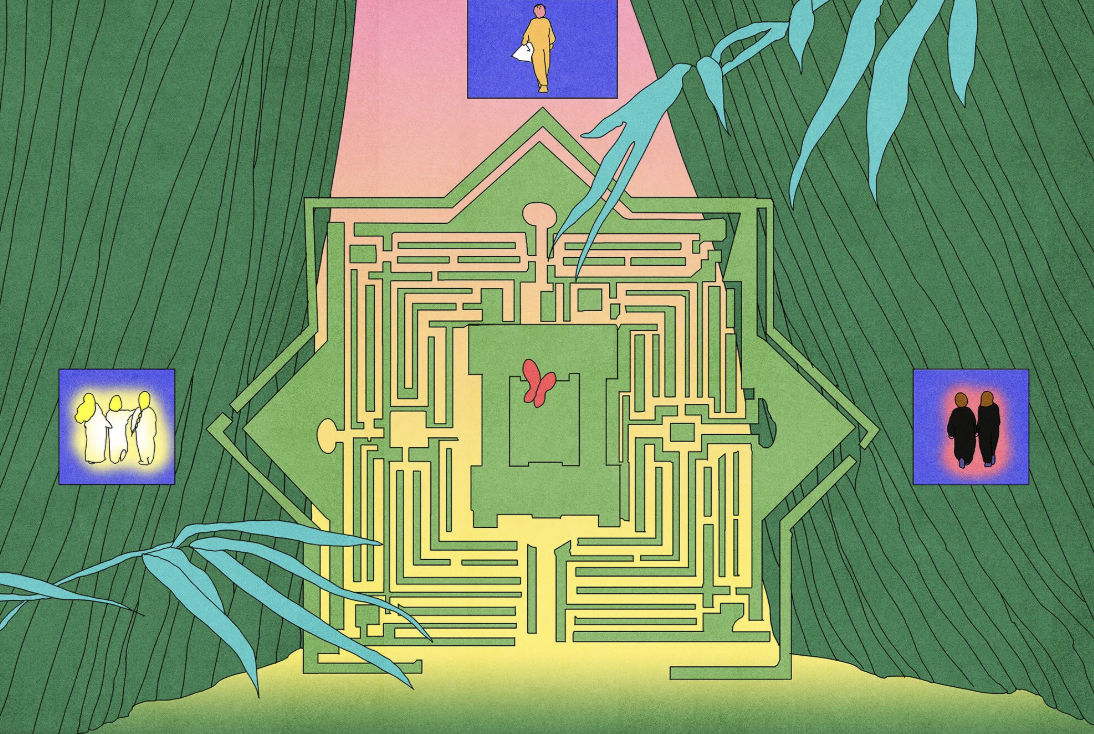
Today, we tend to use the terms labyrinth and maze interchangeably; they are even both defined by the Cambridge Dictionary as “a confusing set of connecting passages or paths in which it is easy to get lost.” We use these words to describe situations where we find ourselves unsure of what choices to make to reach our destination or even unsure of what our destination is. These words help us express our feeling of helplessness in a scenario where a challenge feels unsolvable, where all decisions taken seem to be the wrong ones or make us hit dead ends. The terms labyrinth and maze are even used as metaphors to attempt to explain the human experience, the constant pursuit, the uncertainty, the power of choice and the responsibility of making the “right” choices. But, in their original versions these words are not equivalent, in fact, they are more different that we imagine them to be.
A maze is, as previously defined, a network of passages with branches and dead ends. It is a type of puzzle designed to be confusing and misleading, to have multiple possible paths to exit or even multiple exits. By using a maze as a metaphor for life we are saying that in life there is no single right path that leads us to fulfillment, each needs to find their way of navigating the maze and reaching their destination. In a maze, there are paths that lead nowhere, but in a maze, when you have made a wrong turn, you can always turn and find your way again. In real life, we cannot erase our mistakes from existence, they remain part of our self; just like in a maze, the wrong turns remain part of our trajectory. In a maze, when you hit a dead end and turn around and go back, you have spent time and energy on that wrong path, and you will continue to spend more energy going back to the place you were before you took it, but all that extra effort is worth it knowing that you will be able to solve the maze. Just like in life, it takes a lot of effort to get back from a wrong path, but it is worth it knowing that we are now on the right one. But of course, the most distinctive aspect of a maze is that it is confusing and people often get lost inside of it, which can also be true for life, where we find ourselves unsure of our destination or even where to start. So, a maze seems like an accurate representation of the human experience, with its challenges and its myriad of versions, where fulfillment, or exit, might seem different to each person who walks through the Earth.
Still, if all those wrong turns and mistakes are part of our journey, couldn’t we consider them to be part of the path itself? The original version of a labyrinth features a unicursal path which leads directly to the center and then back again through the same path. This path is far from straight or simple, it is composed of many turns and curves but never branches. In the case of the labyrinth, there are no wrong turns to be made, because all the curves are part of the path itself. There is no shortcut in a labyrinth, one simply has to move forward and experience the whole journey. Unlike a maze, the labyrinth was designed to inspire meditation, by being a puzzle which can only be solved with enough patience. Patience that requires one to navigate the journey without getting too far ahead, patience that inspires reflection. Labyrinths were even described as the “pilgrimage to self,” where the destination is as important as the journey itself. Now, it seems rather unrealistic to say that any challenge faced by humans can be solved with patience, because there are some things that are truly unsolvable, that are beyond our control, but maybe even if we cannot solve them we can choose how to navigate through them.
So, what would you say is a more accurate representation of the human experience: a maze or a labyrinth?