
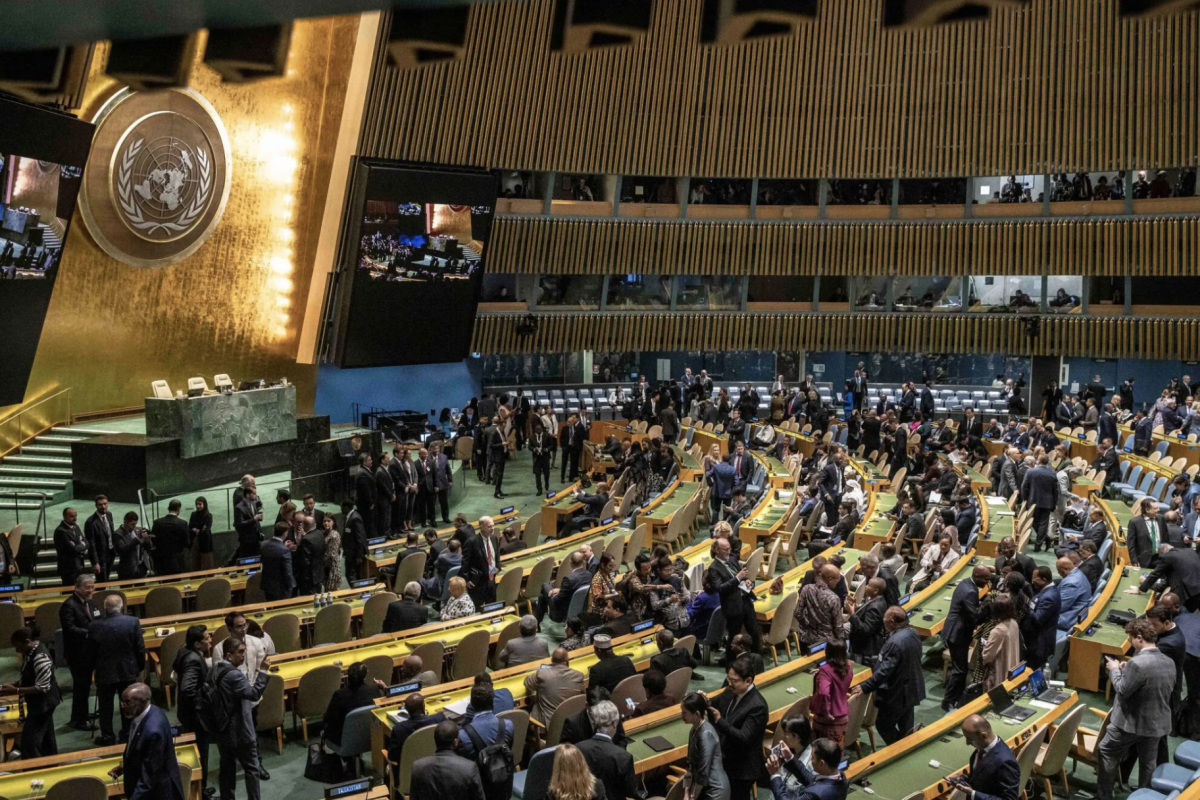
The United Nations is one of the main organizations responsible for global order. It was created in 1945, right after the end of World War II, with the main purpose of preventing future conflict and promoting international stability. However, despite its importance and status, the way it deals with international problems, especially urgent ones, has raised the question: is the United Nations actually effective in solving them?
Before even attempting to answer this question, we need to define what effectiveness should look like for the UN. The UN Charter itself contains the institution’s priorities, which include maintaining international peace and security, promoting peaceful resolution, protecting human rights, providing humanitarian support, and ensuring long-term stability after conflicts, as seen in Articles 1(1), 1(3), and 55 of the Charter.
Looking at history, there are conflicts in which the UN failed to act effectively, such as during the Rwandan Genocide in 1994. As stated in a UN report published in 1999, “The international community did not prevent the genocide, nor did it stop the killing once it had begun.” The genocide resulted in approximately 800,000 deaths over the course of 100 days, in a systematic and brutal massacre of men, women, and children. The same report described it as “one of the most abhorrent events of the twentieth century.” This stands in clear contrast to the International Court of Justice’s rulings, which state that countries have a duty to prevent genocide, as well as to the goals outlined in the UN Charter.

Despite this clear failure, there are also examples where the UN was highly effective. One of these is the Namibian independence process. After World War I, South Africa took control of Namibia, which led to the emergence of armed resistance from a liberation movement called SWAPO (South West Africa People’s Organization). By the 1980s, all sides of the conflict were exhausted, making a negotiated solution possible. In 1989, the UN created UNTAG (United Nations Transition Assistance Group), which was responsible for monitoring ceasefires and supervising elections. Although there was some initial resistance, the UN was eventually able to stabilize the situation. As South African troops gradually withdrew, the UN monitored the process and ensured fair elections and respect for human rights. The result was a 97% voter turnout in a widely recognized, legitimate, and transparent election in 1990, which led to Namibia’s independence and a more stable future.
After analyzing these two cases, we can conclude that the article’s main question does not have a single clear answer. UN effectiveness is influenced by many factors, including political and economic contexts, as well as countries’ responses. The UN faces major challenges due to its complex bureaucratic system, which involves multiple layers of approval and can lead to slow responses to urgent crises. Other limitations include veto power influenced by political interests, dependence on member states for funding, and the lack of its own military force. However, these same features are also designed to protect national sovereignty and encourage diplomacy, which can sometimes lead to successful outcomes, as seen in the case of UNTAG.